Dear Client,
We hope this update finds you and yours doing well as we celebrate 250 years of independence. Amid all the shortcomings and criticisms circulated about the U.S., we consider ourselves truly blessed to be citizens and thereby benefactors of The Great Experiment. We praise God for the freedoms we now have and for the many who throughout our relatively short history have given their lives to provide and protect those very freedoms.
Geographical Concerns
While it seems progress is being made in the conflict with Iran, the lack of stability in the region remains evident. Negotiations have been prolonged and frustrating, while agreements and understandings have consistently been broken. If history tells us anything, having confidence in our sought-after outcomes with Iran over the long term doesn’t seem prudent, yet we hope for the best. At this point the Memorandum of Understanding has at least set the stage for the discussions that could bring this conflict to an end. With that said, we should not be surprised if there are bumps in the road and multiple setbacks ahead.
Economic Growth
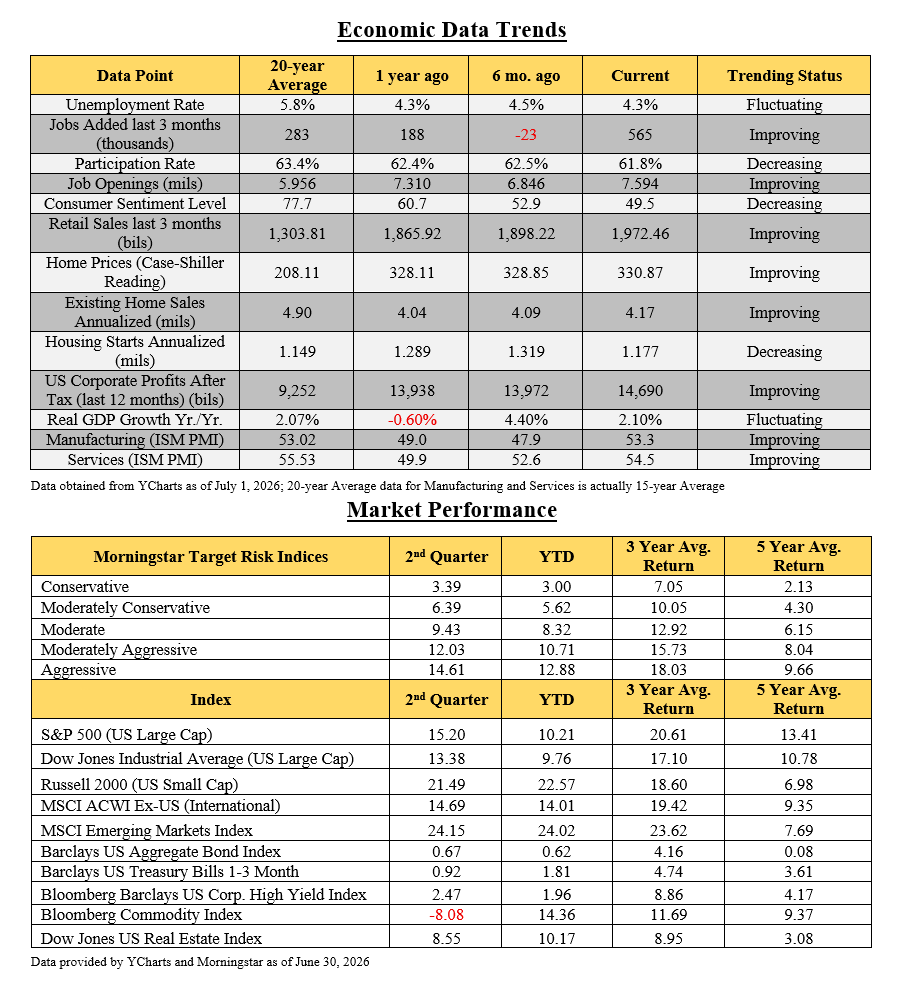
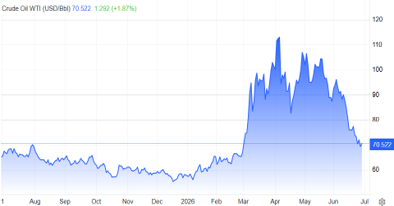
Throughout the first half of the year the economy has remained remarkably resilient. Although the 40% increase in oil prices created a significant “pain at the pump”, it did little to derail the robust expansion we have been experiencing. First quarter GDP was recently revised to a better than expected 2.1% and projections for the second quarter are even higher.
Employment figures have averaged a better than expected 188,000 jobs per month over the last three months. Corporate profits and earnings growth have remained strong. While housing, retail sales and manufacturing have also provided encouraging results. Most recently the “opening” of the strait has brought welcome relief to oil prices falling from a high of more than $112 to under $70 per barrel. Shipping access has also helped bring down prices on fertilizer, minerals, and other commodities shipped primarily through the Strait. Each of these factors give some justification for an optimistic outlook looking to the back half of 2026, however there are still valid concerns as we look ahead.
New Fed Chair, Interest Rates and Inflation
Kevin Warsh, the new Federal Reserve Chair made it clear in his first meeting that returning to a 2% target for inflation is a primary objective for the Reserve. CPI Inflation has been above that target for the past 5 years with the most recent 12-month CPI at 4.2%, well above target. Much of this can be attributed to the recent increase in energy prices. However, positive upticks in employment and strong economic activity have positioned the Fed to more of a hawkish stance on interest rates moving forward.
We started the year with markets forecasting one or two cuts in interest rates, and now it seems likely we will have one or two rate increases prior to year end. Though this may seem like a negative and contrary to the administration’s objectives, it may be necessary to curb inflation. A rate increase will likely only occur if employment figures remain strong, and robust US economic activity continues. Ultimately the fed typically increases interest rates to help curb long-term inflation and sustain long term economic growth.
Markets
As you’ve likely noticed throughout the year, the major market indices have continued to provide strong growth, pushing forward to all-time record highs. Much of that growth being attributed to Artificial Intelligence and their enablers. A recent study from JP Morgan states that 41 AI related companies now comprise almost half of the valuation of the S&P 500. This level of concentration and overall exuberance heightens the need to be sensitive to valuations, sustainable business models, and competition.
Although there has been and will continue to be great demand for AI and technology in general, the question of broader market oversupply to future demand is a concern. Accordingly, selectivity and resisting the temptation to overly concentrate on one segment of the market remains prudent.
With that said, this recent surge in the overall market, driven heavily by the tech sector seems quite different from the dot com bubble of the late 90’s which burst approximately 26 years ago. In the years from 1995 through 1999 the market provided 67% earnings growth and an astounding return of 220%. However, in the most recent five years, the S&P has had 79% earnings growth and a total return of 85%. So, although valuations are still historically quite high, earnings have continued to support the higher equity prices. Since the first of the year, Price-to-Earnings ratios have actually improved because earnings have been so strong. Basically, this means that earnings have been more in line with the market growth, and thereby arguably more supportable.
Other positives to consider are the fact that global credit spreads on bond interest rates are historically low which indicates little investor concern about defaults and is generally a sign of positive investor sentiment. In addition, liquidity within the market is at record levels providing a significant amount of “dry powder” available for future investing, providing even more potential for ongoing growth. So, does this mean we can throw caution to the wind? Not really.
The Buffet Indicator
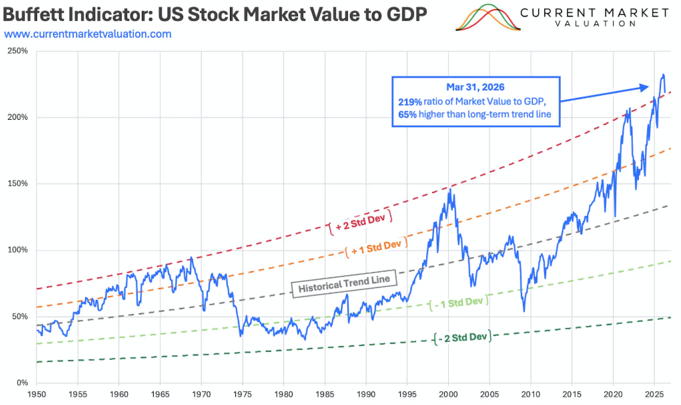
Warren Buffett created a formula many years ago that looks at the market capitalization of the Wilshire 5000 compared to overall US GDP. The following graph shows the current ratio at historically high levels and at a point where the markets have responded very unfavorably in the past to those higher evaluations in relation to GDP.
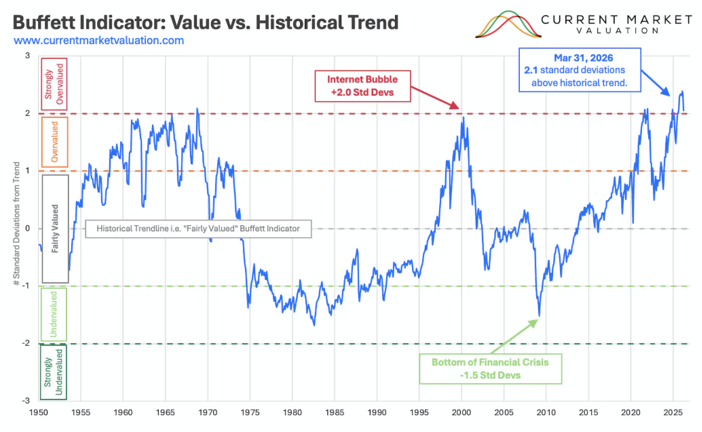
Here is the same graph normalized for easier review.
Although we could experience a market correction again in the near term, I harken back to a time earlier in my career when Alan Greenspan warned of “irrational exuberance” in the market because valuations had been driven so high in relation to their earnings. This was back in December of 1996, and most analysts were predicting a major correction in the near term. That correction happened, but it didn’t occur until March 2000 after the S&P 500 surged an additional 100% and the NASDAQ an additional 300%.
Portfolio
While we do have significant exposure to technology and AI stocks which have fared well for us this year, we still believe it makes sense to maintain strong diversification throughout the broader markets, which has also served us well. Even with the dominance of tech and AI sectors which have heavy representation in the indices, your performance has continued to be very solid this year when compared to the blended benchmarks.
Please take some time to review your updated performance report and the associated economic and market data. Should you have any questions or concerns, please feel free to reach out to us. If we haven’t heard from you, we will keep in touch.
As always, we consider it an honor and privilege to serve you and look forward to doing so for many years to come.
Kindest regards,
Michael Brocker
MSFS, CLU, ChFC, AEP®, AIF®
Chartered Financial Consultant
Masters of Science in Financial Services
Matthew Brocker
MSFS, AEP®, RICP®, CAP®, AIF®
Masters of Science in Financial Services
Josh Brocker
CFP®, AIF®